


- Most Heart Attacks Are Diagnosed After It’s Too Late
- Why Heart Disease Develops Silently
- Why Early Screening Can Prevent 7 of 10 Heart Attacks
- What Is a Cardiac Health Test?
- The Three Biological Stages of a Developing Heart Attack
- What Does an ECG Test Detect and What It Does Not
- Lipid Profile: The Most Important Heart Blood Test
- Is There a Blood Test for Heart Blockage?
- Early Signs of a Blocked Artery
- Types of Heart Tests Used in Preventive Screening
- Heart Health Test Online: Benefits and Limitations
- How Often Should Cardiac Health Tests Be Done?
- Why Most Heart Attacks Occur Without Prior Symptoms
- FAQs
Most Heart Attacks Are Diagnosed After It’s Too Late
Heart attacks are still widely perceived as sudden medical emergencies that strike without warning. This belief has shaped how people approach heart health for decades and it has contributed to millions of avoidable deaths worldwide.
The truth, however, is very different. A heart attack is rarely sudden. It is the final stage of a disease process that begins silently and progresses over many years.
Inside the body, heart disease develops through the gradual narrowing of arteries, cholesterol imbalance, insulin resistance, inflammation, electrical instability, and sustained pressure overload.
These changes occur quietly. By the time chest pain, breathlessness, or collapse appear, the disease is often already advanced.
What makes this global crisis especially preventable is a critical medical fact: most heart attacks show measurable warning signs on a routine cardiac health test anywhere between 3 months and 24 months before the event.
Abnormal lipid profiles, rising blood sugar, silent hypertension, early rhythm disturbances, and hidden plaque formation appear long before symptoms are felt. Yet many people undergo their first cardiac health test only after an emergency admission.
Early detection is not about predicting death; it’s about saving lives.
It is about preventing irreversible damage.
When cardiovascular risk is identified early through structured screening, lifestyle changes and targeted medical interventions can alter disease trajectory long before arteries rupture or blood flow becomes critically compromised. This is why early screening is now considered one of the most powerful tools in modern preventive cardiology.
This article explains how a cardiac health test works, which heart health tests matter most, how early screening can prevent the majority of heart attacks, and why routine testing must now be viewed as a public-health necessity rather than an optional medical step.
Why Heart Disease Develops Silently

A heart attack does not usually occur because something suddenly fails in a single moment. It occurs because several slow, progressive processes continue unchecked for years:
- Arteries gradually lose elasticity
- Cholesterol-rich plaque accumulates inside vessel walls
- Blood chemistry deteriorates
- Insulin resistance worsens
- Chronic inflammation destabilizes plaques
- Long-term stress hormones strain heart muscle
This process unfolds quietly, often without pain or obvious symptoms. During this long silent phase, the body produces clear biological warning signals. These signals are measurable through structured cardiovascular health tests and cardiac health tests, even when an individual feels completely normal.
The tragedy is not that heart attacks occur.
The tragedy is that they are often visible years in advance but remain undetected due to lack of screening.
Why Early Screening Can Prevent 7 of 10 Heart Attacks
Most heart attacks arise from predictable, measurable, and preventable biological abnormalities, including:
- High blood pressure
- Elevated LDL cholesterol and triglycerides
- Low HDL cholesterol
- Poor blood sugar regulation
- Central or abdominal obesity
- Chronic low-grade inflammation
- Electrical rhythm instability
These abnormalities do not develop suddenly. They accumulate slowly over time. When detected early through a cardiac health test, they can be corrected before reaching an irreversible stage.
Early screening prevents heart attacks in three powerful ways:
Identifying Silent Risk Factors Early
Many high-risk abnormalities cause no symptoms. A cardiac health test detects them before damage occurs.
Enabling Timely Lifestyle and Medical Intervention
Early-stage disease responds better to diet, exercise, weight control, blood pressure management, and targeted medication.
Preventing Plaque Rupture and Vessel Occlusion
Stable plaque is manageable. Unstable plaque leads to sudden artery blockage and heart attack.
Late detection treats emergencies.
Early detection prevents emergencies.
What Is a Cardiac Health Test?

A cardiac health test is not a single investigation. It is a structured set of assessments designed to evaluate current heart function and future cardiovascular risk.
A comprehensive cardiovascular health test typically includes evaluation of:
- Electrical activity of the heart – ECG
- Heart structure and pumping efficiency – Echocardiography
- Cholesterol and lipid balance – (Lipid profile)
- Blood sugar regulation – (Fasting sugar, PPBS, HbA1c)
- Inflammatory burden – (High-sensitivity CRP)
- Oxygen delivery capacity (DLCO)
Before conducting any test, it’s always advised to consult a healthcare professional or doctor to conduct more specific tests based on individual need.
Together, these form a heart health test profile—a biological risk map that reveals:
- How efficiently the heart is functioning
- How stressed the arteries are
- Whether plaque formation is likely or progressing
- The probability of a future heart attack or stroke
There is no single test that predicts all cardiac events. Prevention requires multiple types of heart tests used together in a structured manner.
The Three Biological Stages of a Developing Heart Attack

Understanding the stages of heart disease explains why a cardiac health test is so effective.
Stage 1: Metabolic and Chemical Imbalance
This earliest stage includes:
- High Total Cholesterol: Elevated blood fats signaling an overwhelmed lipid system.
- Elevated LDL and Triglycerides: Excess plaque-building materials increasing arterial deposit risk.
- Low HDL: Insufficient “scavengers” to remove excess blood fats.
- Rising Fasting Blood Sugar: Higher glucose levels causing early vascular damage.
- Insulin Resistance: Cells ignore insulin, driving inflammation and strain.
- Elevated Inflammatory Markers (e.g., hs-CRP): Systemic inflammation making arteries more plaque-prone.
At this stage, heart related blood tests are abnormal, but symptoms are absent. This is the most reversible stage of heart disease.
Stage 2: Structural Vascular Damage
If Stage 1 is ignored, disease progresses to:
- Plaque formation inside coronary arteries
- Arterial stiffening
- Reduced vessel elasticity
- Early coronary narrowing
Imaging-based heart test for blockage may detect disease at this stage.
Stage 3: Electrical and Flow Instability
Advanced disease leads to:
- Abnormal heart rhythms
- Reduced oxygen delivery to heart muscle
- Stress-induced ischemia
- Impaired pumping function
At this stage, ECG and stress testing reveal instability. Untreated, this stage often precedes a heart attack.
A cardiac health test aims to identify disease in Stage 1 or Stage 2, where prevention is still possible.
What Does an ECG Test Detect and What It Does Not
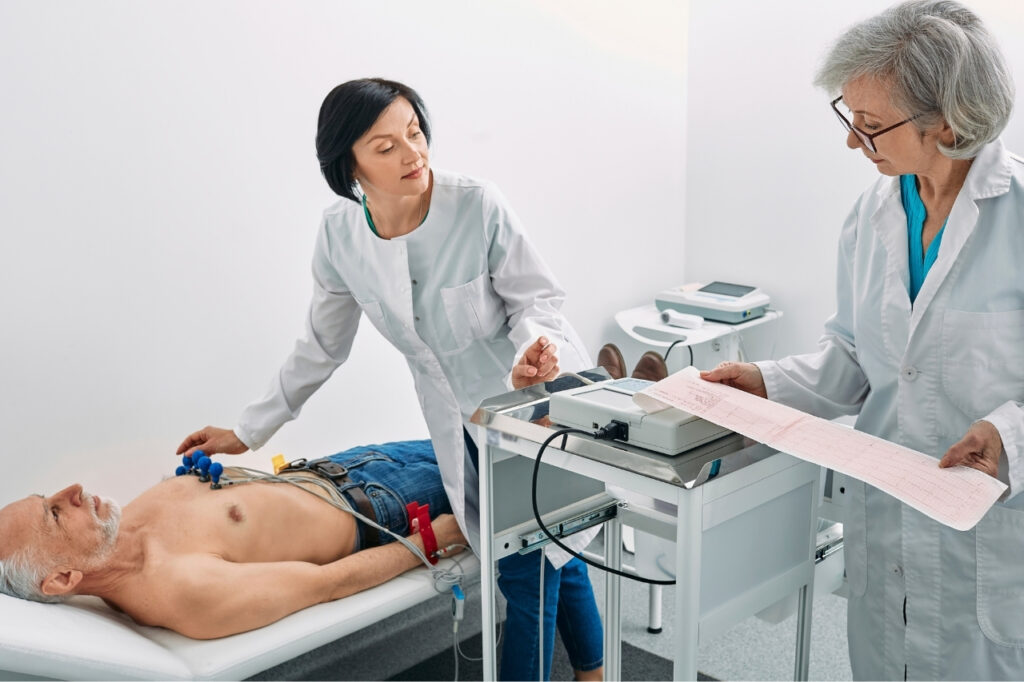
An ECG (Electrocardiogram)is a commonly used heart health test that measures the heart’s electrical activity. It can detect:
- Past silent heart attacks
- Ongoing Ischemia
- Arrhythmias
- Conduction abnormalities
However, ECG does not reliably detect early plaque buildup or mild artery narrowing. For this reason, ECG must be combined with heart related blood tests and imaging as part of a complete cardiac health test strategy.
Lipid Profile: The Most Important Heart Blood Test
A lipid profile is the most important heart blood test name in preventive cardiology. It measures:
- Total cholesterol
- LDL cholesterol
- HDL cholesterol
- Triglycerides
This blood test for heart blockage risk identifies plaque-promoting chemistry years before symptoms appear. Abnormal lipid profiles are directly linked to coronary artery disease, stroke, and peripheral vascular disease.
Without routine lipid testing, many people discover their risk only after a cardiac event.
Is There a Blood Test for Heart Blockage?
There is no blood test that directly visualizes an artery blockage. However, several heart related blood tests strongly predict blockage risk:
- Lipid profile
- High-sensitivity CRP
- HbA1c
- Homocysteine
- Apolipoprotein B
These tests estimate plaque burden and instability and guide early intervention before imaging shows advanced disease.
Early Signs of a Blocked Artery
Blocked arteries may not cause pain initially. Early warning signs include:
- Breathlessness during routine activity
- Fatigue disproportionate to effort
- Chest discomfort during stress
- Jaw, neck, or shoulder tightness
This is why a heart test for blockage should be done proactively rather than symptom-driven.
Types of Heart Tests Used in Preventive Screening
A complete types of heart tests framework includes:
Electrical Tests
- ECG
- Stress ECG
- Holter monitoring
Blood-Based Tests
- Lipid profile
- Sugar panel
- Inflammatory markers
- Cardiac risk enzymes
Imaging Tests
- Echocardiography
- Doppler studies
- CT coronary angiography
Together, these form a standard heart test name list used in preventive cardiology.
Each of the above mentioned tests is used for understanding different aspects of the heart and its function. It’s always advised to consult a healthcare professional before conducting any test, so that the most suitable test can be done based on the current health status.
Heart Health Test Online: Benefits and Limitations
A heart health test online improves access to booking and reports. However, online platforms cannot replace clinical examination, advanced imaging, or physician-led risk interpretation.
Online testing should be viewed as a gateway, not a final diagnostic system.
Heart Health Test Package and Heart Test Price
A heart health test package typically combines ECG, blood tests, and basic imaging. Heart test price varies depending on technology, geography, and package depth.
However, early screening is far less expensive than emergency interventions such as angioplasty, bypass surgery, or long-term heart failure care.
How Often Should Cardiac Health Tests Be Done?
General guidance:
- Below 30 years: Every 3–5 years
- 30–40 years: Every 2–3 years
- 40–50 years: Every 1–2 years
- Above 50 years: Annually
- High-risk individuals: As advised by a physician
- Diabetes
- Obesity
- Smoking
- Family history of early heart disease
- Hypertension
Why Most Heart Attacks Occur Without Prior Symptoms

Heart disease rarely causes pain until late stages. Most patients who suffer heart attacks report:
- No prior chest pain
- No major warning
- No diagnosed heart disease
In reality, risks were present, but undetected due to lack of testing. Absence of symptoms is not the absence of disease..
Screening Does Not Predict Death, It Prevents It
Heart attacks are not random events. They are the predictable outcome of long-standing, measurable biological breakdowns that begin silently and progress steadily.
When a cardiac health test is performed at the right time, risk is identified early, corrective action is taken, and up to 7 out of 10 heart attacks can be prevented.
Screening does not create fear.
It creates foresight.
And foresight saves lives.
Routine cardiac health tests are a cornerstone of preventive healthcare. Early screening enables timely intervention, reduces preventable deaths, and protects long-term cardiovascular health. Periodic testing, guided by healthcare professionals, should be considered an essential part of adult health maintenance.
FAQs
What are the tests for heart health?
Heart health tests include ECG, lipid profile, blood sugar tests, echocardiography, stress testing, coronary calcium scoring, and CT angiography. Each test examines a different dimension of heart function and disease risk.
What are the first signs of a blocked artery?
Early signs include breathlessness on exertion, fatigue, chest discomfort during activity, jaw pain, neck tightness, and declining exercise tolerance. Severe pain often appears only in advanced blockage.
How to check blockage at home?
There is no accurate home method to detect actual artery blockage. Home tools only track indirect indicators like blood pressure and heart rate. Imaging tests are required to confirm blockages.
What are the essential tests to check heart health?
Essential tests include ECG, lipid profile, blood sugar or HbA1c, blood pressure measurement, and echocardiography. These form the foundation of preventive screening.
How often should I get a cardiac health test?
Frequency depends on age and risk level. Most adults above 40 should be screened at least once every 1–2 years, and annually after 50.
What does an ECG test detect?
ECG detects heart rhythm disorders, past heart attacks, conduction blocks, and electrical instability, but does not reliably detect early vessel blockages.
What is a lipid profile, and why is it important for heart health?
A lipid profile measures cholesterol and triglycerides. It identifies plaque-building risk years before symptoms or blockages develop, making it a cornerstone of prevention.

Written By: CPH Editorial Team
Medically Reviewed By: Dr Ananya Adhikari



Pingback: Cardiac Health Tests – A Preventive Approach to Heart Care – capitalisthealth